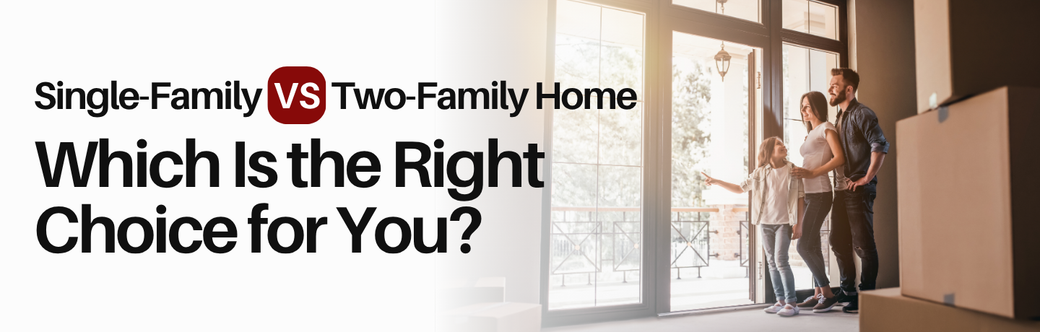
Single-Family vs. Two-Family Home: Which Is the Right Choice for You?
A Practical Look at Buying Power, Financing, Lifestyle, and Long-Term Goals
If you're looking to buy a home in New York, you may be deciding between a single-family and two-family home.
Both can be great options, but the decision is about more than privacy or rental income. Your financing, buying power, the homes available in the neighborhoods you want, and how comfortable you are with the responsibilities of owning a two-family property all matter.
For some buyers, a single-family home may provide the privacy and simplicity they want. For others, an owner-occupied two-family may offer more space, flexibility, and the potential for rental income.
Instead of asking only, “Which type of home do I prefer?”, consider a more practical question:
“What can I realistically buy under each scenario, and which option makes the most sense for me?”
Single-Family vs. Two-Family: Understanding the Difference
A single-family home is designed for one household. You typically have the entire property for yourself, including the living areas, bedrooms, kitchen, bathrooms, and outdoor space.
For many buyers, one of the biggest benefits is privacy. There is no second household living on the property, and there are generally fewer responsibilities beyond managing your own home.
A single-family home may be a good fit if you:
- Prefer more privacy
- Want a simpler living arrangement
- Don't want to manage tenants
- Want the entire property for your household
- Prefer fewer property-related responsibilities
An owner-occupied two-family is different. The buyer lives in one unit as their primary residence and rents out the other.
Depending on the property, the two units may have separate kitchens, bathrooms, bedrooms, living areas, and entrances.
For some New York buyers, this can provide an opportunity to own a home while also generating rental income. It can also provide separate space for family members or give the owner more flexibility as their needs change.
Look at Your Buying Power Under Both Scenarios
When buyers receive a pre-approval, they often start by looking at single-family homes within that price range.
But if you're also open to an owner-occupied two-family, it's worth asking your lender how that scenario would be evaluated.
Depending on the loan program, lender guidelines, appraisal, documentation, and the buyer's qualifications, some rental income from the second unit may be considered when determining mortgage qualification. This can potentially affect the range of properties a buyer can consider, but it does not automatically increase their buying power.
Your lender will determine what income can be used and how the property and loan are evaluated based on your individual circumstances.
That makes it useful to look at two scenarios:
Scenario 1: Single-Family
What am I approved for, and what single-family homes can I realistically buy in the neighborhoods I want?
At a particular price point, you may find that the available homes are smaller than you expected, need significant renovation, or require a compromise on location.
Scenario 2: Owner-Occupied Two-Family
If I purchase a two-family, how would my lender evaluate the property and any qualifying rental income from the second unit?
If the financing and your qualifications allow that income to be considered, you may have a different group of properties to evaluate.
That could mean more space, a different location, better condition, or simply more options. But it could also turn out that the difference is small.
The important thing is to understand what each scenario realistically allows you to purchase before deciding which property type is right for you.
Compare the Actual Homes, Not Just the Property Types
Once you understand what each financing scenario may allow, look at the homes that are actually available.
This is where the decision can become much more practical for New York buyers.
For example, your single-family budget in a particular neighborhood may only give you homes that need significant renovation, are smaller than you need, or require you to compromise on location.
If you're open to an owner-occupied two-family, you may find a completely different group of properties — perhaps something in better condition, with more space, or a layout that works better for your family.
In practice, this is often where the decision becomes much clearer: once you see what your budget actually buys in each category, you're no longer comparing two property types in theory, you're comparing real homes, real monthly costs, and real trade-offs.
Compare the actual homes based on:
- Purchase price
- Monthly payment
- Property taxes and insurance
- Condition and expected repairs
- Size and layout
- Location
- Potential rental income
- Ongoing expenses
- Privacy
- Long-term plans
A two-family property may give you access to a home you prefer, but that doesn't automatically make it the better decision.
If the financial opportunity isn't significant enough to justify having a tenant and taking on additional responsibilities, the single-family home may still be the better fit.
Rental Income Comes With Responsibilities
Potential rental income can be an important part of the decision, but it isn't free money.
If you live in one unit and rent the other, you're also becoming a landlord.
That can mean dealing with:
- Tenant screening
- Rent collection
- Maintenance and repairs
- Vacancies
- Tenant turnover
- Utilities and shared areas
- Insurance and other property expenses
- Applicable rental requirements and responsibilities
You also need to consider your time and privacy.
A tenant may need a repair. The rental unit may be vacant between tenants. Shared outdoor areas, entrances, laundry, or utilities may require coordination depending on the property.
For some buyers, these responsibilities are manageable and the financial benefit is worth it.
For others, having their own single-family home with no tenant responsibilities may be worth much more.
Two-Family Homes Can Offer More Than Rental Income
Rental income isn't the only reason buyers consider a two-family.
The second unit may provide useful flexibility. Depending on the buyer's situation, it could be used for:
- A tenant
- Parents or other family members
- An adult child
- Future living arrangements
That flexibility can be valuable as your needs change.
At the same time, you should consider whether you actually want to share the property with another household.
Having separate units can provide some privacy, but it is not the same as owning a single-family home where the entire property is yours.
A Realistic Buyer Example
Imagine a buyer who is pre-approved and wants to stay in a particular New York neighborhood.
They start looking at single-family homes and realize that their budget may only get them a smaller property, a home that needs significant work, or a location that isn't their first choice.
Because they're open to living in one unit of a two-family, they speak with their lender about how that type of property would be evaluated.
If they qualify under the applicable financing requirements, they may now have a different group of homes to consider.
Maybe they find a two-family with more space or a better layout. But now they have another question to answer:
Is that opportunity worth having a tenant, taking on maintenance and other landlord responsibilities, and giving up some privacy?
That's the real comparison.
Sometimes the answer is yes. Sometimes it is no.
Single-Family or Two-Family: What Should You Choose?
A single-family home may be the better choice if you value:
- Privacy
- Simplicity
- Having the entire property to yourself
- Fewer management responsibilities
- A home that already fits your needs within your budget
An owner-occupied two-family may be worth exploring if you:
- Are comfortable living alongside another household
- Want rental income
- Need additional space or flexibility
- Are comfortable with landlord responsibilities
- Find that the two-family option gives you access to better properties in your target area
The important thing is not to assume one property type is better than the other.
The Right Choice Depends on the Market
The comparison can also look different from one New York neighborhood to another.
In some areas, single-family and two-family homes may both be common, giving buyers several options to compare.
In another area, two-family homes may be more expensive, less available, or simply not provide enough financial benefit to justify the additional responsibilities.
That's why buyers should look at the actual inventory in the neighborhoods they want rather than relying on a general rule.
Neither property type is automatically the better choice.
The right answer depends on your financing, the available homes, your budget, your lifestyle, and your long-term plans.
Final Thoughts
If you're open to both a single-family and an owner-occupied two-family, don't make the decision based on property type alone.
Start by understanding what you can realistically afford and qualify for under each scenario. Then look at the actual homes those numbers give you access to.
Compare the purchase price, monthly payment, condition, size, location, potential rental income, expenses, privacy, and responsibilities.
If you're considering a two-family, speak with your lender about how the financing would work and how potential rental income may be treated under your specific loan program.
Sometimes the single-family home will clearly be the better choice.
Sometimes the two-family will open the door to better options.
And sometimes the potential financial benefit simply won't be worth becoming a landlord.
The best choice isn't the property that looks better on paper. It's the one that makes sense for your finances, your lifestyle, and your long-term goals.
FAQs
Can rental income from a two-family home help me qualify for a mortgage?
Depending on the loan program and your individual circumstances, qualifying rental income from the second unit may be considered. Speak with your lender to understand how the income would be treated for your specific loan.
Does buying a two-family automatically increase my buying power?
No. A two-family does not automatically mean you will qualify for a larger mortgage. Your lender will determine how the property and any qualifying rental income are treated based on the applicable financing guidelines and your qualifications.
What should I compare when looking at a single-family and two-family?
Compare the actual homes, not just the property types. Look at purchase price, monthly costs, condition, size, location, potential rental income, expenses, privacy, and the responsibilities that come with each property.
Is a two-family home better than a single-family home?
Not necessarily. A two-family may offer rental income, more space, or flexibility, while a single-family may provide more privacy and a simpler lifestyle. The right choice depends on the buyer and the actual homes available.
What should I consider before choosing between the two?
Ask yourself:
- What can I realistically afford and qualify for?
- Which actual homes fit my budget and goals?
- Am I comfortable being a landlord?
- Is the potential financial benefit worth the reduced privacy and additional responsibilities?
- Which option makes more sense for my lifestyle and long-term plans?
Categories
Recent Posts